
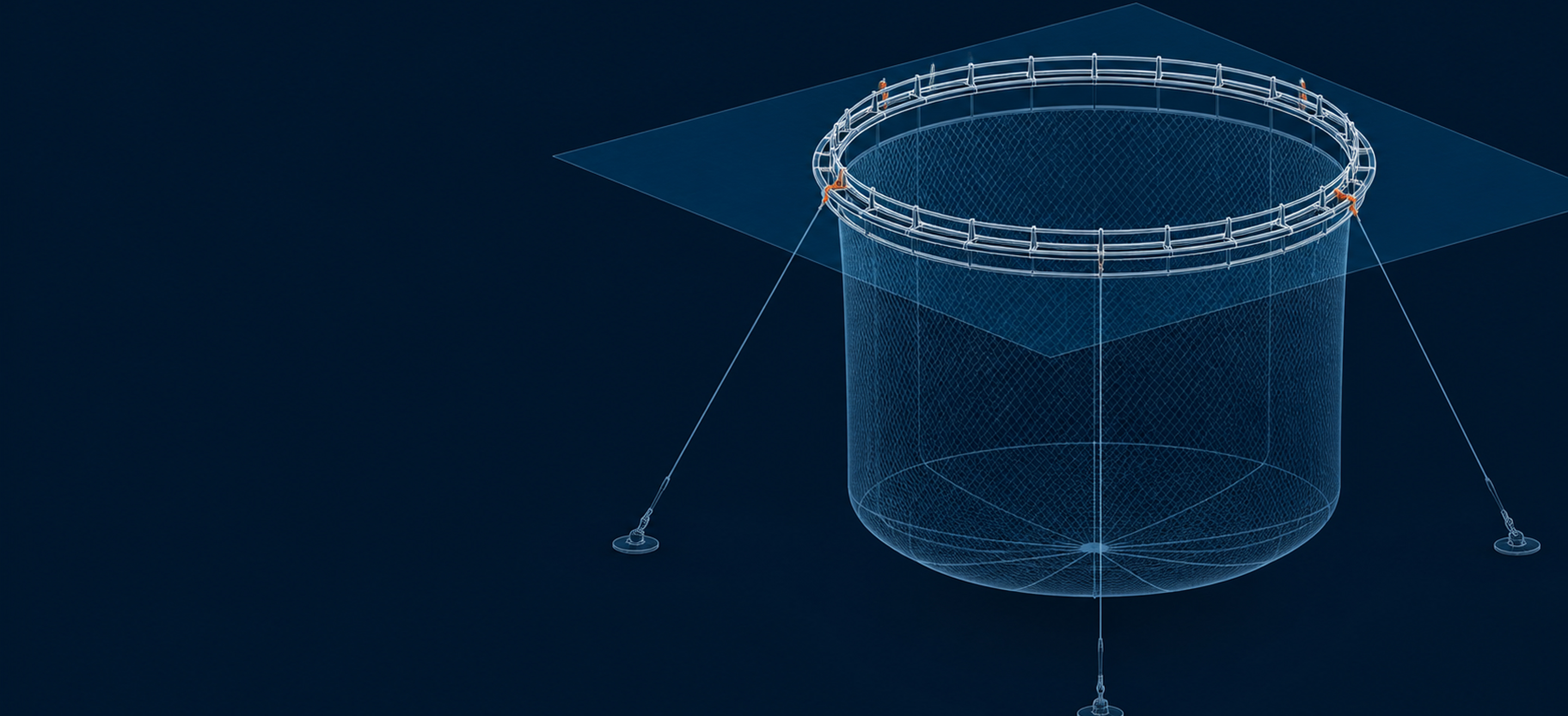
Before going to sea, understand the ocean first.
Hydrodynamic & Structural Simulation Turn wind, waves and currents into an analyzable design boundary.
Identify the question first, then build the model.
Every calculation addresses a specific engineering question — not just a result contour.
How does it move?
Displacement, attitude and time-domain response under combined wind, wave and current.
How is load transferred?
Variation and transmission of forces on the floating frame, net and mooring.
How is it constrained?
Mooring layout, line tension and the overall constraint relationship.
How is safety ensured?
Safety factors of each structural component and effective aquaculture volume of the cage.
Structure, net and mooring, analyzed together.
Based on site environment and geometry inputs, study cage group motion, frame loads, cable tension and net displacement.
Environmental input & constraint
Site wind, wave, current, water depth and structural geometry together define the model boundary.
Motion & load response
Observe how critical locations vary with load cases and time through time-domain computation.
Let results enter the design decision.
Put assumptions, load cases and results into one traceable engineering document.
- 01Load Cases & AssumptionsData sources, boundary conditions, simplifications and applicable scope.
- 02Structural & Flow ResultsMotion, loads, tension, net displacement and velocity distribution.
- 03Risk & Adjustment DirectionStructural parameters, interfaces and supplementary data to be adjusted.
EVIDENCE / SOURCE FIGURE
Displacement curve · Click to view original
Already have site data, or an initial structural concept?
Complete data helps us define the modeling scope more accurately. Missing data will be explicitly recorded as assumptions and items to be confirmed.
Environmental Boundary
Wind, wave, current, water depth and key load cases
Structural Data
Geometry, materials, floats, nets and mooring
Analysis Objective
Responses of interest, scheme comparison and design questions
Keep the critical questions before going to sea.
Submit your existing data and questions of interest, confirm the analysis scope and engineering data list.
Discuss Simulation Needs